Quantification and Human Differentiation
Quantification is a technique that assigns numerical values to objects, expressing complex and chaotic occurrences in abstract terms and thus making them readable, comparable, and calculable. The assignment of numerical values functions both as a technique of distinction and of aggregation, and depending on the context, numbers can emphasize either the uniqueness or the generality of what is being described. Quantification techniques have been used by states since the mid-19th century to understand populations and formed the basis of political economy. Particularly under the auspices of consumer capitalism, people were translated into numbers, assigned prices, and traded as commodities and risks, for example in the insurance market. Numbers and prices suggest “objective” or “true” values. However, quantification is a highly complex process that usually remains invisible but draws on or creates categories, evaluates them, and hierarchizes them. Quantification is the basis on which statistical calculations, the commodification of human lives, and their translation into monetary values function. In this workshop, we will examine the historical processes of quantification and the creation of statistical individuals and commodified human lives. We will question which human differentiating distinctions factor into quantification processes and how topics such as the standard of living, sociality, productivity, and normality/deviance become the basis for new human differentiations.
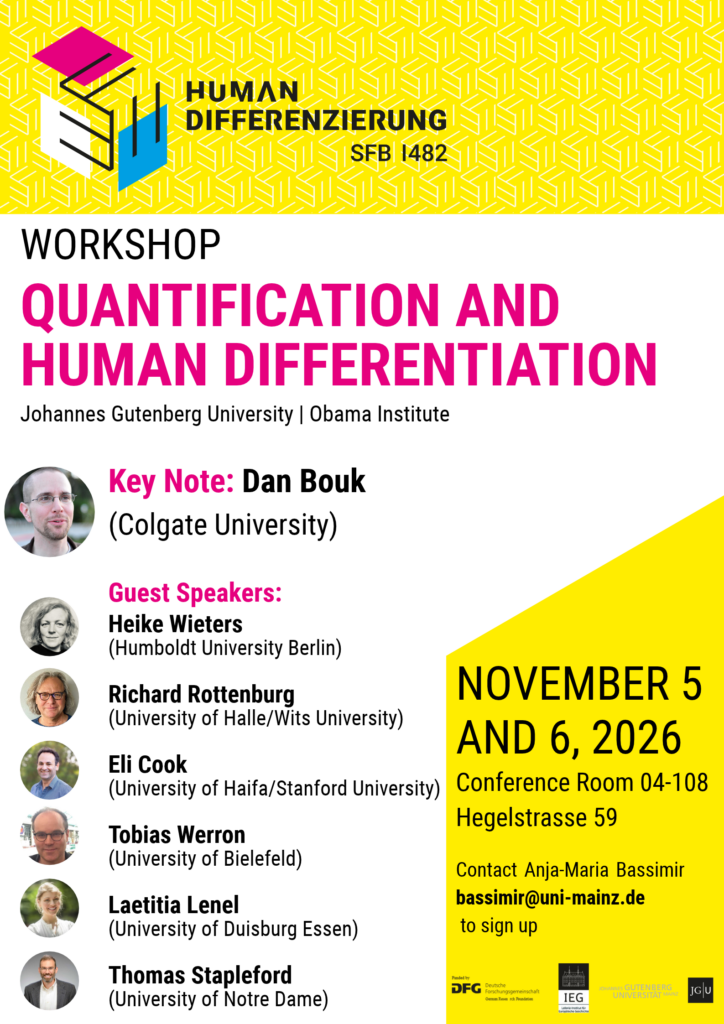
Speakers:
Dan Bouk
Professor of History, Colgate University, Hamilton, NY, USA
Heike Wieters
Junior Professor for European Historical Research, Department of History, Humboldt University of Berlin, Germany
Prof. Dr. Heike Wieters - Humboldt-Universität zu Berlin
Richard Rottenburg
Research Professor of Science and Technology Studies at Wits University, Johannesburg, South Africa, and Professor Emeritus of Science and Technology Studies, Department of Anthropology and Philosophy, University of Halle, Germany
richard.rottenburg@ethnologie.uni-halle.de
Eli Cook
Research Fellow at the Center for Advanced Study in the Behavioral Sciences, Stanford University, USA, and Associate Professor, General History Department, University of Haifa, Israel
Tobias Werron
Professor of Sociological Theory and General Sociology, Department of Sociology, University of Bielefeld, Germany
tobias.werron@uni-bielefeld.de
Prof. Tobias Werron - Universität Bielefeld
Laetitia Lenel
Junior Professor for Cultural Economic History, Department of History, University of Duisburg Essen, Germany
Personen im Historischen Institut: Prof. Dr. Laetitia Lenel
Thomas Stapleford
Associate Professor in the Program of Liberal Studies at the University of Notre Dame, USA
Thomas A. Stapleford | People | Program of Liberal Studies | University of Notre Dame
Anja-Maria Bassimir
Research Associate at the Obama Institute for Transnational American Studies and the Collaborative Research Center 1482 Human Categorization at the Johannes Gutenberg University Mainz, Germany
Anja-Maria Bassimir | Obama Institute for Transnational American Studies
Axel Schäfer
Professor of U.S. History at the Obama Institute for Transnational American Studies at Johannes Gutenberg University Mainz, Germany
Axel Schaefer | Obama Institute for Transnational American Studies